
A whole piece is too much. Four bars are not.
Gradiano cuts a score into four-bar blocks, takes your hands up a short ladder of steps for each one, then joins the blocks until the piece plays from start to finish. In the browser, with your MIDI keyboard.
How a session goes
Every session is the same five moves. The app sets up each step; you keep your hands on the keys.
-
Pick a piece
Open an arrangement from the library, or bring your own score.
-
Play the block
The step sets the hand, the tempo, the loop and the metronome. Wait steps hold at every note until the right keys are down; tempo steps start at 60%.
-
Hear the coach
Every slip is named on the staff and on the keys: a wrong pitch or octave, a missed, extra, early, late, short or long note, a split chord.
Wanted G3, heard F♯4. Aim for the lit key.
-
Join the seams
Two mastered neighbours open a pair, four open a section, all of them the whole piece: each one pass, both hands, in tempo.
-
Perform
Play it through with falling notes, the sheet and the keyboard. Nothing is judged.
Why it works this way
The method follows what research has found about practice. The exact numbers are our starting points; the practice log shows how they hold up.
-
What you retain follows the share of correct passes, not the time spent.
So each step keeps a tempo at which most passes come out clean.
Duke, Simmons & Cash, 2009 -
Performers remember a piece by its structure.
So mastered blocks are joined back into pairs, sections and the whole, and the seams get practised.
Chaffin & Imreh, 2002 -
Sleep between sessions makes playing more accurate.
So a daily goal and a streak of days, rather than marathons.
Simmons, 2011 -
Falling notes get beginners playing fast; whether they learned to read was not measured.
So Practise reads from the score, and falling notes belong to Perform.
Rogers et al., 2014
Then just play
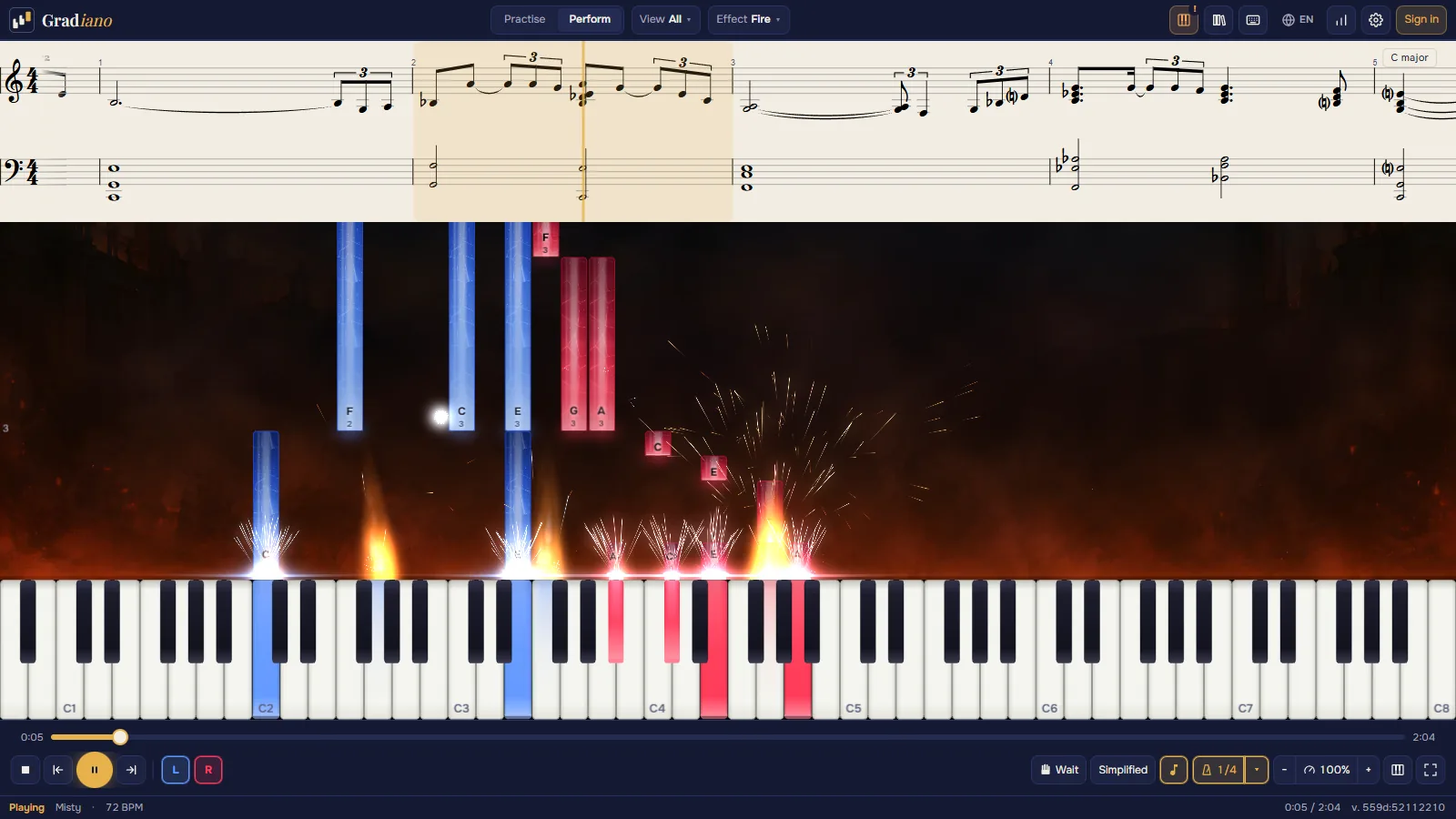
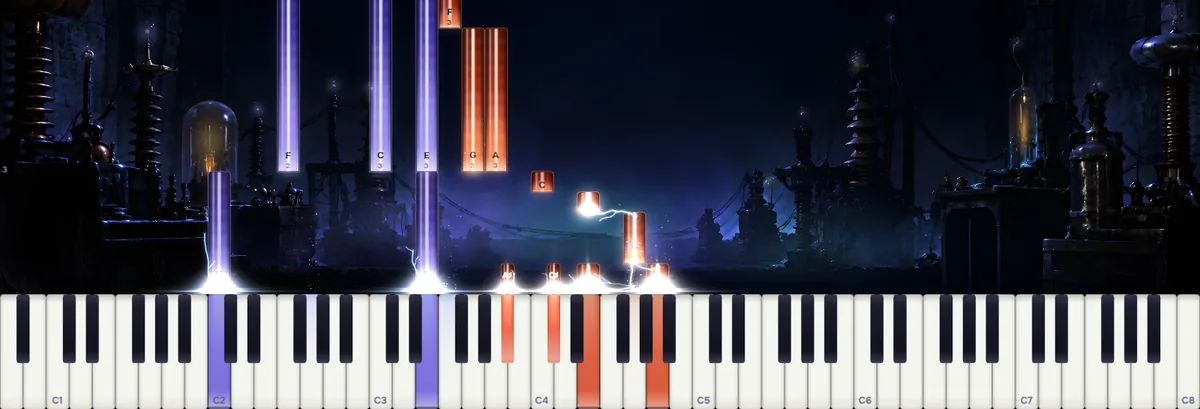
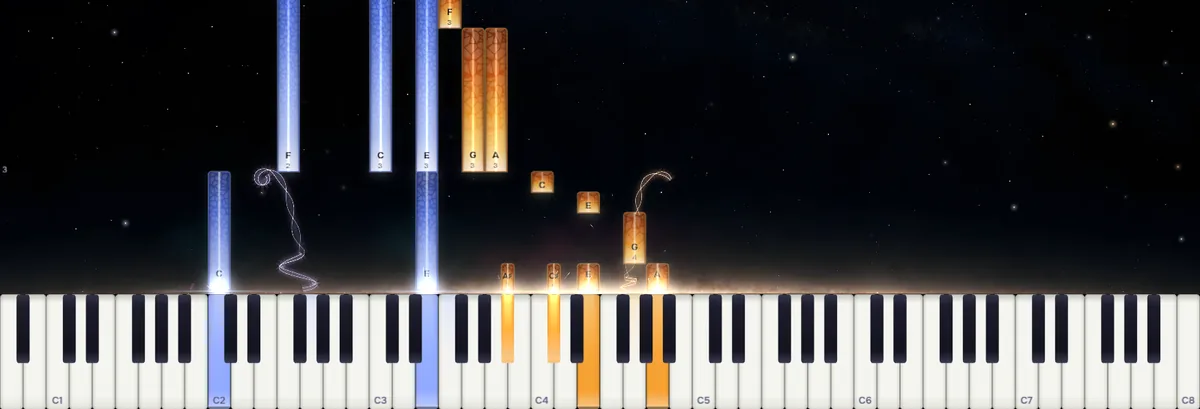
Notes fall onto the keys and burn away in fire, electricity or space, with real 2D physics. With reduced motion, they are cut cleanly at the keys.
Your music
- In
- MusicXML keeps the full notation and opens Practise. A PDF or a photo of sheet music is recognised into a score. A MIDI file plays at once, an audio recording once it is transcribed, and both are turned into a score for Practise.
- Out
- MIDI, MusicXML, PDF or MP3.
What you need
- A MIDI keyboard, over USB or Bluetooth.
- Chrome or Edge.
- Nothing to install. Added as an app, it opens without a connection too; importing and syncing need one.
- Practise as a guest, or sign in with Google to keep your library and progress in your account.
- English, Spanish or Russian.
Hands stay on the keys
Hold the lowest key, A0, then press another: C4 plays or pauses, B3 and C5 step between blocks, F4 and G4 make it slower or faster.
Questions
Can I learn piano with a MIDI keyboard?
Yes. Connect any MIDI keyboard over USB or Bluetooth and open Gradiano in Chrome or Edge. It hears every key you press, waits for the right notes on Wait steps and names each slip.
How do I learn a piano piece faster?
Practise it in small parts at a tempo you can play cleanly, then join the parts. Gradiano does this with you: it cuts the score into four-bar blocks, raises the tempo step by step from 60% once your passes come out clean, and joins mastered blocks into pairs, sections and the whole piece.
Can I use it without a MIDI keyboard?
You can open any score, listen to it and watch it play with falling notes. The practice steps need a MIDI keyboard: Gradiano judges what you play by its keys.
Can it turn a MIDI file or a PDF into sheet music?
Yes. Gradiano turns a MIDI file, a PDF, a photo of sheet music or an audio recording into a score you can practise, and exports it as MusicXML, PDF, MIDI or MP3.
Where do the free scores come from?
From open score projects such as Mutopia and Noctave. Each score on the Sheet music page shows its source and licence, and opens in the piano in one click.
Four bars tonight.
Plug in your keyboard and open a piece. The first block is waiting.
Open Gradiano